Most early-stage founders don’t have a CFO. They have QuickBooks, a bunch of tools, a spreadsheet, and their gut. Last year (2025), Surbhi Jain, and Varun Sant, and I teamed up to understand and test whether AI could fill that gap by reasoning through the decisions that matter most.
Our project came out of a FIELD Course at Harvard Business School called Ideation and Prototyping for Innovation (IPI). We relied heavily on Research-Driven Innovation (RDI) to find problems we cared about solving. Our team wanted to help startups and businesses in their day-to-day operations and finance quickly stood out as a function that was highly consequential and required a good level of expertise.
Research and Earned Insights
We conducted 28 interviews across 22 founders, 3 VCs, and 3 finance platform operators, all at early or growth-stage startups. The goal was to understand how founders make high-stakes financial decisions when they don’t have a traditional finance team in the room.
The Judgement Trilemma
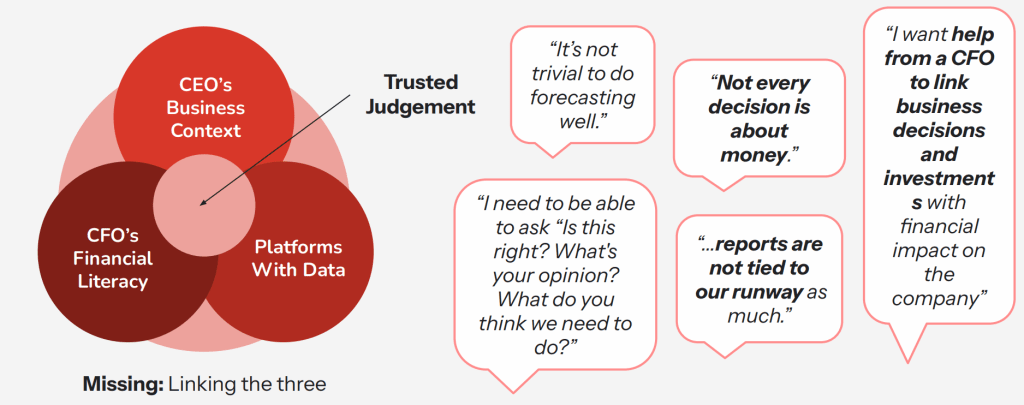
The finding that kept surfacing: existing tools automate, but they don’t reason. Founders were asking for something that could connect their business context to their financial reality and help them think through a decision.
We called this the Judgement Trilemma, or the gap that exists when financial literacy, complete business context, and trustable tools aren’t all present at once.
Context is not integrated
Context is the hard problem. Many existing tools for accounting and management of finances show the right numbers, but they may not be able to connect those numbers to business priorities, company stage, and industry-specific logic. The tools don’t attend important meetings or know that the company values an organic growth strategy over paid advertising.
Co-pilot, not auto-pilot
Founders are comfortable delegating accounting and reconciliation, but fundraising, prioritization, and final sign-offs stay human. The tool needs to reduce time-to-decision and improve output quality, and understand the right steps to keep human-in-the-loop. Observing how the best finance professionals approach this can give insights on how to design tools.
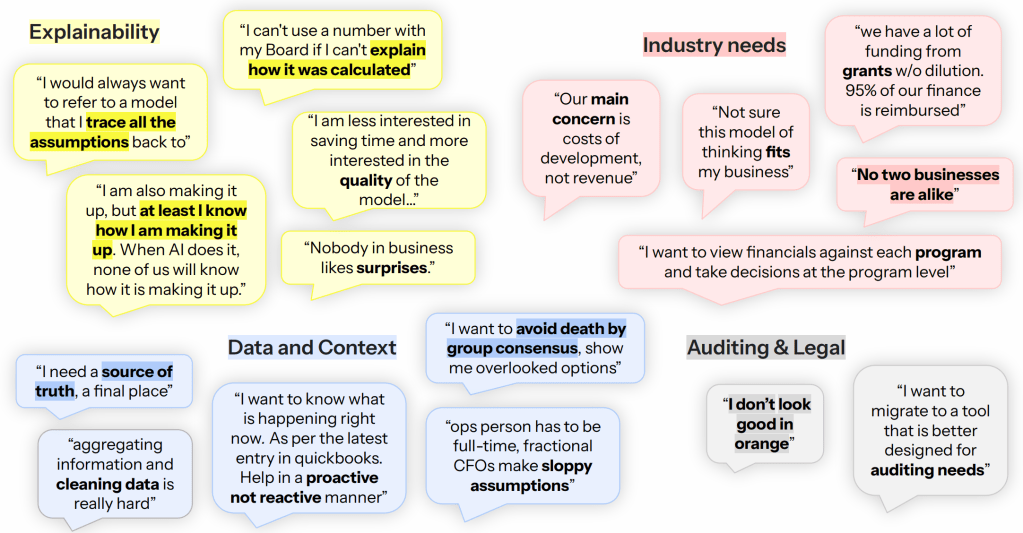
Founders need explainability above everything. The most repeated phrase across interviews: “I can’t use a number with my Board if I can’t explain how it was calculated.” Trust in AI output is conditional and has to be earned.
Rainmaker: The Prototype
We wanted concrete feedback on whether users will trust AI to make decisions for them, so we built a quick prototype to show in later user interviews. We called it Rainmaker, an AI financial co-pilot for startup founders designed around three core jobs: turning real-time data into explainable scenarios, surfacing assumptions for the user to verify, and allowing integrations with tools like QuickBooks and Ramp and form a single context layer.
The prototype was built in Lovable. (Link to demo, note that this is a UI walkthrough and not a live product).
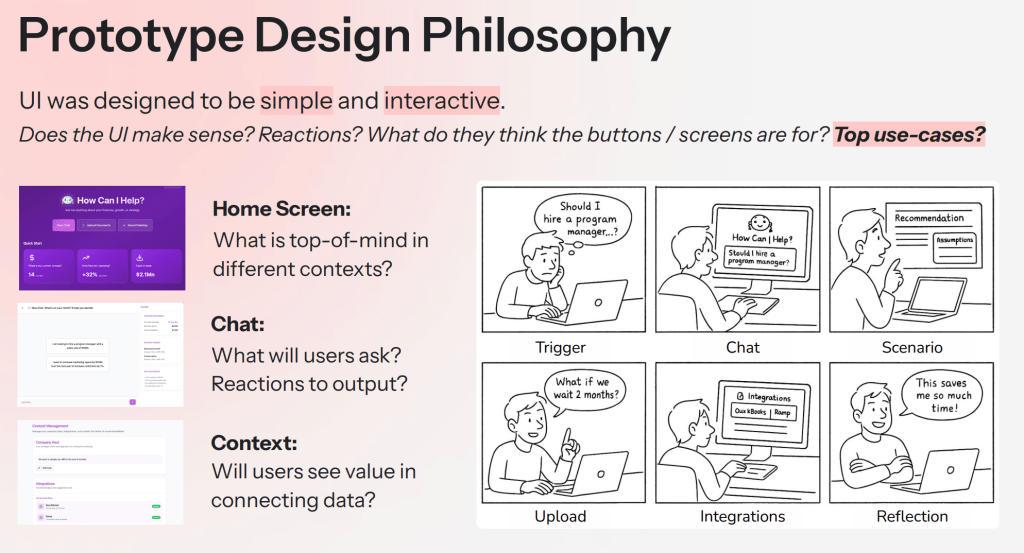
Testing the prototype with founders validated two hypotheses: they would connect their data if confidentiality and anonymization were guaranteed, and they would trust the output if it was explainable, audit-ready, and grounded in their actual financial models.
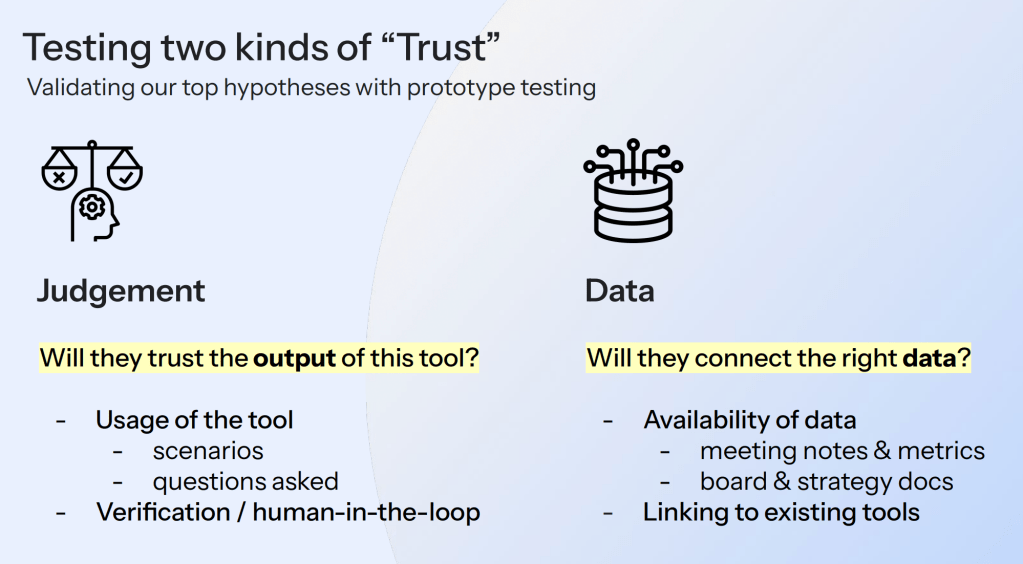
Founders don’t lack data, they lack a trusted thought-partner for making decisions. Hiring accounting professionals ad-hoc can be helpful in early stages but it cannot replace the trust that comes with having someone who knows the company inside-out and can see the trajectory unfold with complete context.
Here’s more of what we heard from customers:
 Krutika Kalkal